Even though ARC cores itself don't have any power management except SLEEP
state it's possible to use power management features of selected peripherals.

For example USB OTG requires PM_RUNTIME which is only available if
kernel/power/Kconfig is sourced by architecture.

Signed-off-by: Alexey Brodkin <[email protected]>
Signed-off-by: Vineet Gupta <[email protected]>
Architectures only need a Kconfig entry for NO_DMA if it is possible
that its value will be 'y'. For arc its value will always be 'n', making
it pointless. Remove it.

Signed-off-by: Paul Bolle <[email protected]>
Signed-off-by: Vineet Gupta <[email protected]>
All the platforms do the same thing in init_machine callback so move it
out of callback into caller of callback

Signed-off-by: Vineet Gupta <[email protected]>
If the renamed symbol is defined lib/iomap.c implements ioport_map and
ioport_unmap and currently (nearly) all platforms define the port
accessor functions outb/inb and friend unconditionally.  So
HAS_IOPORT_MAP is the better name for this.

Consequently NO_IOPORT is renamed to NO_IOPORT_MAP.

The motivation for this change is to reintroduce a symbol HAS_IOPORT
that signals if outb/int et al are available.  I will address that at
least one merge window later though to keep surprises to a minimum and
catch new introductions of (HAS|NO)_IOPORT.

The changes in this commit were done using:

	$ git grep -l -E '(NO|HAS)_IOPORT' | xargs perl -p -i -e 's/\b((?:CONFIG_)?(?:NO|HAS)_IOPORT)\b/$1_MAP/'

Signed-off-by: Uwe Kleine-König <[email protected]>
Acked-by: Arnd Bergmann <[email protected]>
Signed-off-by: Andrew Morton <[email protected]>
Signed-off-by: Linus Torvalds <[email protected]>
A number of Kconfig entries default to (uppercase) "N". It was clearly
intended to use "default n". But since (lowercase) "n" is the default
anyway, these lines might as well be removed.

Signed-off-by: Paul Bolle <[email protected]>
Signed-off-by: Jiri Kosina <[email protected]>
Pull ARC changes from Vineet Gupta:
 - IPI optimization and cleanups
 - Support for bootloader provided external Device Tree blobs

* tag 'arc-v3.14-rc1' of git://git.kernel.org/pub/scm/linux/kernel/git/vgupta/arc:
  ARC: [cmdline] support External Device Trees from u-boot
  ARC: [cmdline] uboot cmdline handling rework
  ARC: [SMP] optimize IPI send and receive
  ARC: [SMP] simplify IPI code
  ARC: [SMP] cpu halt interface doesn't need "self" cpu-id
  ARC: [SMP] IPI ACK interface doesn't need "self" cpu-id
  ARC: [SMP] cpumask not needed in IPI send path
Remove an outdated reference to "most personal computers" having only one
CPU, and change the use of "singleprocessor" and "single processor" in
CONFIG_SMP's documentation to "uniprocessor" across all arches where that
documentation is present.

Signed-off-by: Robert Graffham <[email protected]>
Signed-off-by: Andrew Morton <[email protected]>
Signed-off-by: Linus Torvalds <[email protected]>
* Moved cmdline copy from asm to "C" - allows for more robust checking
  of pointer validity etc.

* Remove the Kconfig option to do so, base it on a runtime value passed
  by u-boot

Signed-off-by: Vineet Gupta <[email protected]>
Lockdep required a small fix to stacktrace API which was incorrectly
unwindign out of __switch_to for the current call frame.

Signed-off-by: Vineet Gupta <[email protected]>
After the last architecture switched to generic hard irqs the config
options HAVE_GENERIC_HARDIRQS & GENERIC_HARDIRQS and the related code
for !CONFIG_GENERIC_HARDIRQS can be removed.

Signed-off-by: Martin Schwidefsky <[email protected]>
Merge Kconfig menu diet patches from Dave Hansen:
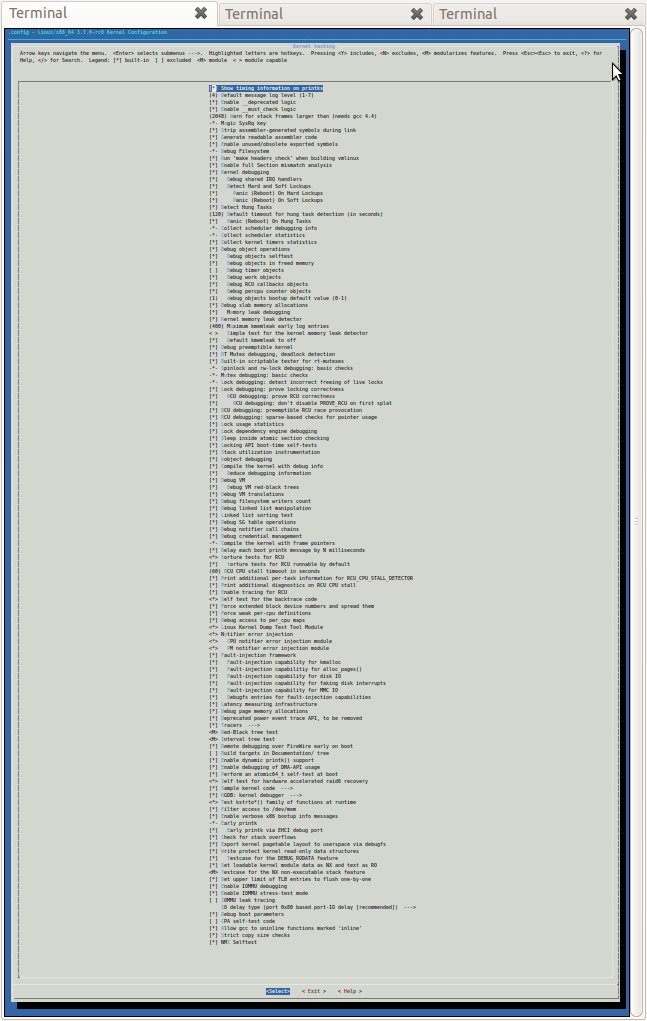
 "I think the "Kernel Hacking" menu has gotten a bit out of hand.  It is
  over 120 lines long on my system with everything enabled and options
  are scattered around it haphazardly.

        http://sr71.net/~dave/linux/kconfig-horror.png

  Let's try to introduce some sanity.  This set takes that 120 lines
  down to 55 and makes it vastly easier to find some things.  It's a
  start.

  This set stands on its own, but there is plenty of room for follow-up
  patches.  The arch-specific debug options still end up getting stuck
  in the top-level "kernel hacking" menu.  OPTIMIZE_INLINING, for
  instance, could obviously go in to the "compiler options" menu, but
  the fact that it is defined in arch/ in a separate Kconfig file keeps
  it on its own for the moment.

  The Signed-off-by's in here look funky.  I changed employers while
  working on this set, so I have signoffs from both email addresses"

* emailed patches from Dave Hansen <[email protected]>:
  hang and lockup detection menu
  kconfig: consolidate printk options
  group locking debugging options
  consolidate compilation option configs
  consolidate runtime testing configs
  order memory debugging Kconfig options
  consolidate per-arch stack overflow debugging options
Original posting:

	http://lkml.kernel.org/r/[email protected]

Several architectures have similar stack debugging config options.
They all pretty much do the same thing, some with slightly
differing help text.

This patch changes the architectures to instead enable a Kconfig
boolean, and then use that boolean in the generic Kconfig.debug
to present the actual menu option.  This removes a bunch of
duplication and adds consistency across arches.

Signed-off-by: Dave Hansen <[email protected]>
Reviewed-by: H. Peter Anvin <[email protected]>
Reviewed-by: James Hogan <[email protected]>
Acked-by: Chris Metcalf <[email protected]> [for tile]
Signed-off-by: Dave Hansen <[email protected]>
Signed-off-by: Linus Torvalds <[email protected]>
1. For VM_EXEC based delayed dcache/icache flush, reduces the number of
   flushes.

2. Makes this security feature ON by default rather than OFF before.

3. Applications can use mprotect() to selectively override this.

4. ELF binaries have a GNU_STACK segment which can easily override the
   kernel default permissions.
   For nested-functions/trampolines, gcc already auto-enables executable
   stack in elf. Others needing this can use -Wl,-z,execstack option.

Signed-off-by: Vineet Gupta <[email protected]>
This is the meat of the series which prevents any dcache alias creation
by always keeping the U and K mapping of a page congruent.
If a mapping already exists, and other tries to access the page, prev
one is flushed to physical page (wback+inv)

Essentially flush_dcache_page()/copy_user_highpage() create K-mapping
of a page, but try to defer flushing, unless U-mapping exist.
When page is actually mapped to userspace, update_mmu_cache() flushes
the K-mapping (in certain cases this can be optimised out)

Additonally flush_cache_mm(), flush_cache_range(), flush_cache_page()
handle the puring of stale userspace mappings on exit/munmap...

flush_anon_page() handles the existing U-mapping for anon page before
kernel reads it via the GUP path.

Note that while not complete, this is enough to boot a simple
dynamically linked Busybox based rootfs

Signed-off-by: Vineet Gupta <[email protected]>
Infrastructure required to make the Linux kernel compile and boot on the
Abilis Systems TB10x series of SOCs based on ARC700 CPUs:
  - Kmake related files (Kconfig, Makefile, tb10x_defconfig)
  - TB10x platform initialisation

Signed-off-by: Christian Ruppert <[email protected]>
Signed-off-by: Pierrick Hascoet <[email protected]>
Signed-off-by: Vineet Gupta <[email protected]>
Given that DeviceTree /bootargs can provide similar functionality,
no point in providing duplicate infrastructure.

Signed-off-by: Vineet Gupta <[email protected]>
This tracks mainline commit ae903caae2 "Bury the conditionals from
kernel_thread/kernel_execve series" which we missed out as ARC port was
not yet mainline.

[vgupta: commit log modified]

Signed-off-by: Alexander Shiyan <[email protected]>
Signed-off-by: Vineet Gupta <[email protected]>
commit "fs: make binfmt support for #! scripts modular and removable"
made support for #!scripts optional - thus need to include the Kconfig
file to get all relevant BINFMT_*

Signed-off-by: Vineet Gupta <[email protected]>
Currently ARC_HAS_LLSC can be influenced by platform for SMP only using
ARC_HAS_COH_LLSC. For !SMP it defaults to "y".

It turns out that some customers can't support it all, even in UP.
So we change the semantics, and use a negative dependency ARC_CANT_LLSC.
Any platform (independent of SMP or !SMP) can select it to disable LLSC.

Signed-off-by: Vineet Gupta <[email protected]>
All the current platforms can work with 0x8000_0000 based dma_addr_t
since the Bus Bridges typically ignore the top bit (the only excpetion
was Angel4 PCI-AHB bridge which we no longer care for).
That way we don't need plat-specific cpu-addr to bus-addr conversion.

Hooks still provided - just in case a platform has an obscure device
which say needs 0 based bus address.

That way <asm/dma_mapping.h> no longer needs to unconditinally include
<plat/dma_addr.h>

Also verfied that on Angel4 board, other peripherals (IDE-disk / EMAC)
work fine with 0x8000_0000 based dma addresses.

Signed-off-by: Vineet Gupta <[email protected]>
Cc: Arnd Bergmann <[email protected]>
Acked-by: Arnd Bergmann <[email protected]>
This is more natural and is now doable since the choice constructs are
gone.

Signed-off-by: Vineet Gupta <[email protected]>
Acked-by: Arnd Bergmann <[email protected]>
This mini patchseries addresses the lack of multi-platform-image support
in ARC port.

Older build system only supported one platform(soc) to build at a time
and further only one board of that platform could be built. There was no
technical reason for that - we just didn't have the need.

So the first step towards multi-platform (and multi-board) builds it to
allow build system to do that.

So as applicable, <choice .. endchoice> => <menu .. endmenu>

Signed-off-by: Vineet Gupta <[email protected]>
Cc: Arnd Bergmann <[email protected]>
Acked-by: Arnd Bergmann <[email protected]>
Implement ioremap_prot() to allow mapping IO memory with variable
protection
via TLB.

Implementing this allows the /dev/mem driver to use its generic access()
VMA callback, which in turn allows ptrace to examine data in memory
mapped regions mapped via /dev/mem, such as Arc DCCM.

The end result is that it is possible to examine values of variables
placed into DCCM in user space programs via GDB.

CC: Alexey Brodkin <[email protected]>
CC: Noam Camus <[email protected]>
Acked-by: Vineet Gupta <[email protected]>
Signed-off-by: Gilad Ben-Yossef <[email protected]>
Signed-off-by: Vineet Gupta <[email protected]>
This allows ARC Target to do I/O to host in absence of any peripherals
whatsoever, assisted by Metaware Hostlink facility.

Further we have a FUSE based filesystem which makes us mount/access host
filesystem on target and do fops.

Signed-off-by: Vineet Gupta <[email protected]>
* Includes mapping of CCMs in address space
* Annotations to move arbitrary code/data into CCM
* Moving some of the critical code/data into CCM
* Runtime detection/reporting

Signed-off-by: Vineet Gupta <[email protected]>
ARC700 doesn't natively support unaligned access, but can be emulated
-Unaligned Access Exception
-Disassembly at the Fault address to find the exact insn (long/short)

Also per Arnd's comment, we runtime control it using 2 sysctl knobs:
* SYSCTL_ARCH_UNALIGN_ALLOW: Runtime enable/disble
* SYSCTL_ARCH_UNALIGN_NO_WARN: Warn on each emulation attempt

Originally contributed by Tim Yao <[email protected]>

Signed-off-by: Vineet Gupta <[email protected]>
Cc: Tim Yao <[email protected]>
Acked-by: Arnd Bergmann <[email protected]>
-Originally written by Rajeshwar Ranga
-Derived off of generic unwinder in 2.6.19 and adapted to ARC

Signed-off-by: Vineet Gupta <[email protected]>
Cc: Rajeshwar Ranga <[email protected]>
ARC common code to enable a SMP system + ISS provided SMP extensions.

ARC700 natively lacks SMP support, hence some of the core features are
are only enabled if SoCs have the necessary h/w pixie-dust. This
includes:
-Inter Processor Interrupts (IPI)
-Cache coherency
-load-locked/store-conditional
...

The low level exception handling would be completely broken in SMP
because we don't have hardware assisted stack switching. Thus a fair bit
of this code is repurposing the MMU_SCRATCH reg for event handler
prologues to keep them re-entrant.

Many thanks to Rajeshwar Ranga for his initial "major" contributions to
SMP Port (back in 2008), and to Noam Camus and Gilad Ben-Yossef for help
with resurrecting that in 3.2 kernel (2012).

Note that this platform code is again singleton design pattern - so
multiple SMP platforms won't build at the moment - this deficiency is
addressed in subsequent patches within this series.

Signed-off-by: Vineet Gupta <[email protected]>
Cc: Arnd Bergmann <[email protected]>
Cc: Thomas Gleixner <[email protected]>
Cc: Rajeshwar Ranga <[email protected]>
Cc: Noam Camus <[email protected]>
Cc: Gilad Ben-Yossef <[email protected]>
There is a bit of hack/kludge right now where we disable preemption if a
L2 (High prio) IRQ is taken while L1 (Low prio) is active.

Need to revisit this

Signed-off-by: Vineet Gupta <[email protected]>
This is minimal infrastructure needed for devicetree work.
It uses an a sample "skeleton" devicetree - embedded in kernel image -
to print the board, manufacturer by parsing the top-level "compatible"
string.

As of now we don't need any additional "board" specific "machine_desc".

TODO: support interpreting the command line as boot-loader passed dtb

Signed-off-by: Vineet Gupta <[email protected]>
Cc: Arnd Bergmann <[email protected]>
Cc: Grant Likely <[email protected]>
Cc: [email protected]
Cc: Rob Herring <[email protected]>
Cc: James Hogan <[email protected]>
Reviewed-by: Rob Herring <[email protected]>
Reviewed-by: James Hogan <[email protected]>
Includes following fixes courtesy review by Al-Viro

* Tracer poke to Callee-regs were lost

  Before going off into do_signal( ) we save the user-mode callee regs
  (as they are not saved by default as part of pt_regs). This is to make
  sure that that a Tracer (if tracing related signal) is able to do likes
  of PEEKUSR(callee-reg).

  However in return path we were simply discarding the user-mode callee
  regs, which would break a POKEUSR(callee-reg) from a tracer.

* Issue related to multiple syscall restarts are addressed in next patch

Signed-off-by: Vineet Gupta <[email protected]>
Cc: Al Viro <[email protected]>
Acked-by: Jonas Bonn <[email protected]>
 Alexey Brodkin